- How much do cleaners charge per hour?
- Prices per square foot
- Cost by facility type
- Why rates break on small buildings
- How much to charge for office cleaning
- How to price a cleaning job
- What your labor actually costs
- Is your price right?
- Where these numbers come from
- What a good price is worth if the inquiry never reaches you
- Frequently asked questions
Nobody publishes a rate card in commercial cleaning. Providers do not say what they charge, buyers rarely say what they paid, and every guide you find quotes a different range from the last one.
What follows is what the published ranges actually say, where they agree, and the one place almost all of them go wrong in a way that costs small operators money.
How much do commercial cleaners charge per hour?
Published 2026 ranges cluster between $30 and $50 an hour per cleaner, with high-cost metros reaching $75.
That spread is wide because it mixes markets. A cleaner in Mississippi and a cleaner in Massachusetts are not really in the same business, and the wage difference between them runs to more than 60%.
Hourly pricing suits small jobs, unpredictable scopes, one-off cleans and post-construction work, and it is simpler to quote when a lead qualification call has not yet established the full scope. For recurring contracts it works against you, because it caps your upside the moment you get faster at the building. Square footage pricing rewards efficiency; hourly pricing quietly punishes it.
Commercial cleaning prices per square foot
For standard recurring office cleaning, published 2026 ranges converge on $0.07 to $0.20 per square foot per month, with most sources placing the middle at $0.10 to $0.18.
Per month, not per visit. Nothing else on this page matters as much as that distinction. Several published guides state a per-square-foot rate "per visit" and then give a worked example that only makes sense monthly. Run the arithmetic and it settles immediately: a 10,000 square foot office at $0.12 per square foot is $1,200 a month, which matches every published monthly example. Priced per visit at three visits a week it would be over $15,000 a month, which matches nothing.
If you have been comparing your rate against a per-visit figure, you have been comparing against a number roughly thirteen times too large.
Frequency is baked into the published range and almost never stated. Most rate charts are built on a three-visits-a-week program. If you clean the same building five nights a week you are doing 21 visits a month instead of 13, and the monthly rate has to move with it.
It does not scale in a straight line, and this catches people out in both directions. Doubling the visits does not double the monthly price, because a building cleaned more often is less dirty each time. ISSA states plainly that more frequent cleaning tends to lower the per-square-foot rate, because efficiency improves with routine service. Buildingstars puts the same point in operator terms: four times a week does not cost twice what twice a week costs.
Working from a $0.15 per square foot per month figure at three visits a week, the direction looks roughly like this:
Read these as direction, not precision. The monthly figure rises with frequency, and it rises by less than the visit count does. Seven days a week is the exception that breaks the pattern, because staffing every day is harder and costs more.
The practical consequence for a low-frequency account: a building cleaned once a week costs more per visit than the same building cleaned nightly, and quoting it off a three-times-a-week rate card will leave you short.
Commercial cleaning cost per square foot by facility type
Per square foot per month, at roughly three visits a week:
Two adjustments apply on top. Compliance documentation, multi-shift coverage and full scope push toward the top of every range. Reduced frequency and lighter scope pull toward the bottom.
Why per square foot rates break on small buildings
Most published rate charts leave this out of the number itself, and it is where small operators quietly lose money. The industry acknowledges it in prose and then publishes a single size-neutral range anyway.
Per-square-foot benchmarks are drawn from large buildings. One provider's published figures show a 50,000 square foot office on overnight cleaning running $6,000 to $9,000 a month, which is $0.12 to $0.18 per square foot. That is a real number for that building.
Apply the same rate to a 6,000 square foot office and you get $720 to $1,080 a month, and you will lose money on it.
It happens because a large part of your cost does not scale down with the building.
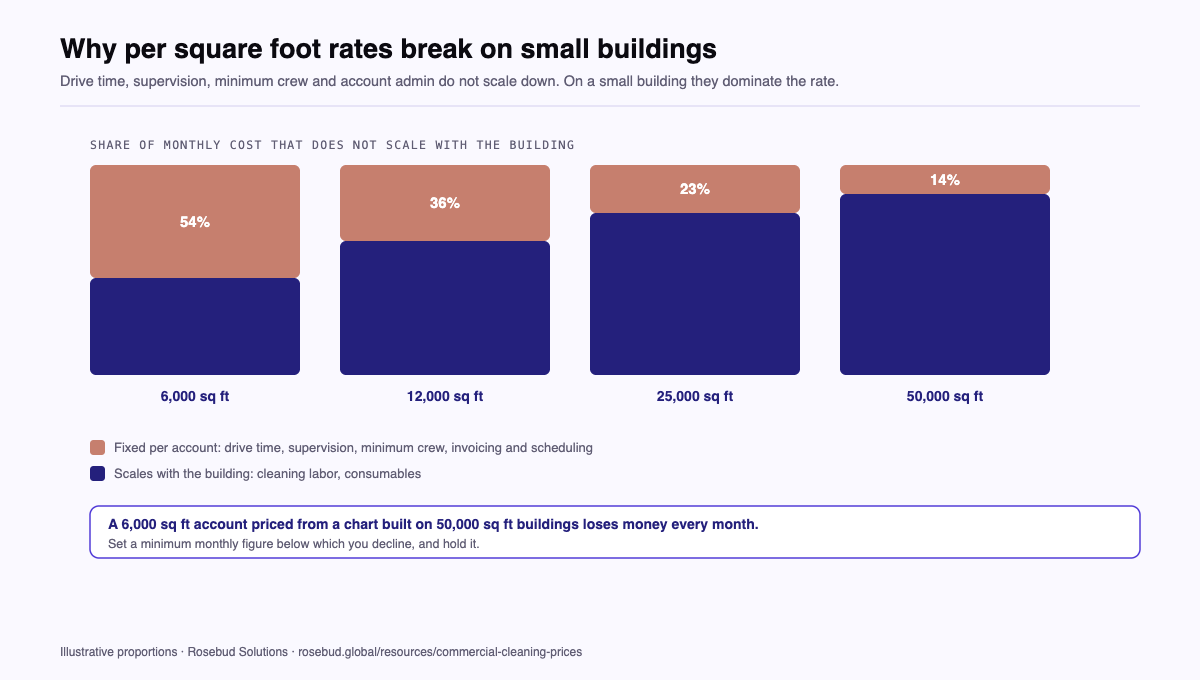
- Drive time is fixed per visit. Forty-five minutes each way costs you an hour and a half of paid labor whether the building is 6,000 square feet or 60,000.
- Supervision is fixed per account. Someone inspects the work and takes the client's calls regardless of size.
- Minimum crew is fixed. You cannot send half a cleaner. A building needing 1.5 hours still occupies someone for a full shift once travel is counted.
- Account administration is fixed. Invoicing, scheduling and the client relationship cost the same on a small account as a large one.
Spread across 50,000 square feet those costs disappear into the rate. Spread across 6,000 they dominate it.
The practical consequence: small buildings carry a materially higher rate per square foot than the published charts suggest, and there is nothing wrong with that. A 5,000 to 10,000 square foot account priced at $0.25 to $0.35 per square foot per month at higher frequency is not overpriced. It is priced for what it costs to serve.
This is not a fringe view. Nilfisk states that smaller sites carry higher rates per square foot because setup time and overhead stay the same, and that larger buildings cost less per square foot through scale. Angi notes that small offices often carry a minimum service charge. Buildingstars confirms that cleaning companies maintain minimum pricing thresholds specifically to cover travel, commuting and administrative cost.
Most cleaning companies learn this by winning a small building at chart rate and quietly losing money on it for a year. Set a minimum monthly figure below which you decline an account, and hold it.
How much to charge for office cleaning
Working figures for a standard office at three visits a week, before adjusting for your own costs:
Notice how the rate per square foot falls as the building grows, which is the small-building effect above expressed the other way round.
Treat these as a starting position for a conversation rather than a quote, since the quote comes out of the calculation below.
How to price commercial cleaning jobs
Four steps, and the order matters, because every one of them depends on the step before it.
1. Measure cleanable square footage, not gross. Exclude storage, server rooms, closets and anything not being cleaned. Gross footage inflates the building and produces a rate that looks competitive and is not.
2. Convert footage to hours using production rates. A production rate is how many square feet one cleaner covers per hour for a given task. The ISSA 612 cleaning times standard is the industry reference. Published general-office figures vary by source, roughly 2,500 to 4,200 square feet per hour, and slower spaces run far below it.
Break the building into area types and rate each separately. Restrooms are the slowest area in any building and applying an open-office rate to them is the commonest reason a bid comes in short.
3. Cost the hours at your fully loaded rate. Not the wage, for the reasons set out in the next section.
4. Add the costs that are not labor, then build the margin in by dividing.
Dividing gives you the margin. Adding a percentage on top does not. On $2,000 of cost, a 30% target priced by division is $2,857. Priced by markup it is $2,600, and your actual margin is 23%.
What your labor actually costs
Quoting from the wage rather than the fully loaded rate is the single most common pricing error in this trade.
The US Bureau of Labor Statistics puts the median hourly wage for janitors and building cleaners at $17.27 as of May 2024, with the lowest 10% under $13.26 and the highest 10% above $23.58. That is the wage, and it is the smallest component of what an hour actually costs you.
On top of it sit payroll taxes, workers' compensation, general liability allocation, and any benefits. Together these commonly add 15% to 25%. A $17 wage is realistically $20 to $21 an hour before a single supply cost.
Then the non-labor monthly costs: drive time, vehicle and fuel, supervision, chemicals, consumables you are billed for, equipment depreciation, uniforms, and a share of your overhead. Insurance alone, general liability plus a janitorial bond, runs around $700 a year for a small operation, and it belongs in your overhead rather than coming out of your profit.
How to tell whether your price is right
Price per square foot is the number everyone quotes and the weakest check available, because it moves with frequency, building size and facility type all at once, which means two perfectly correct bids on similar buildings can differ by a factor of three.
The check that travels is effective hourly revenue. Divide your monthly bid by the total labor hours in the month and compare the result to your fully loaded hourly rate.
This ratio holds regardless of building size, frequency or market, which is exactly what a per-square-foot figure cannot do.
Two more checks sit alongside it: your break-even monthly figure, which you never bid below, and the minimum account size below which you decline outright, which is the discipline the small-building problem demands.
Get the bid template
Two parts. Part one is a pricing worksheet you keep: production rates by area type, fully loaded labor rate, the costs most bids forget, and a margin formula you cannot get wrong. Part two is the bid document you send, with scope, exclusions, insurance, references and a follow-up schedule.
Where these numbers come from
The rate ranges on this page are drawn from published 2026 pricing guides from field service software companies, national franchise operators and consumer quote marketplaces, cross-checked against each other and against their own worked examples. Where sources disagreed, the arithmetic decided, which is how the per-visit versus per-month question above was settled.
Wage figures are from the US Bureau of Labor Statistics. Production rate guidance references the ISSA 612 cleaning times standard, and the frequency and building size effects are corroborated by ISSA, Nilfisk, Angi and Buildingstars.
Two honest caveats. Published ranges are what providers say they charge, not audited transaction data, and no such dataset exists publicly for this industry. And every range on this page is a national figure, in an industry where the wage gap between the highest and lowest paying states is over 60%. Use them to orient, then price from your own measured costs.
What a good price is worth if the inquiry never reaches you
All of this pricing discipline only pays if the quote request arrives and somebody answers it.
In the 2026 US Service Business Response Study we sent a real inquiry to 273 US service businesses, 55 of them commercial cleaning companies. Cleaning was the strongest of the five sectors tested and still only 41.3% of delivered inquiries drew any reply within 72 hours, with 30.4% answered by a person. 9.1% of cleaning companies had no working web inquiry form at all. The median reply took 5.1 hours.
A quote request that sits unanswered for five hours is priced at zero, whatever your rate card says. The wasted lead spend calculator puts a monthly figure on that. Three checks worth running on your own business this week:
- Submit a test inquiry through your own website from a phone on cellular data and confirm it arrives.
- Time how long a quote request actually waits before somebody replies.
- Check what happens to a request that arrives at 7pm on a Friday.
That is lead management rather than lead generation, and it is usually the cheapest margin available to a cleaning company, because the demand has already been paid for.